


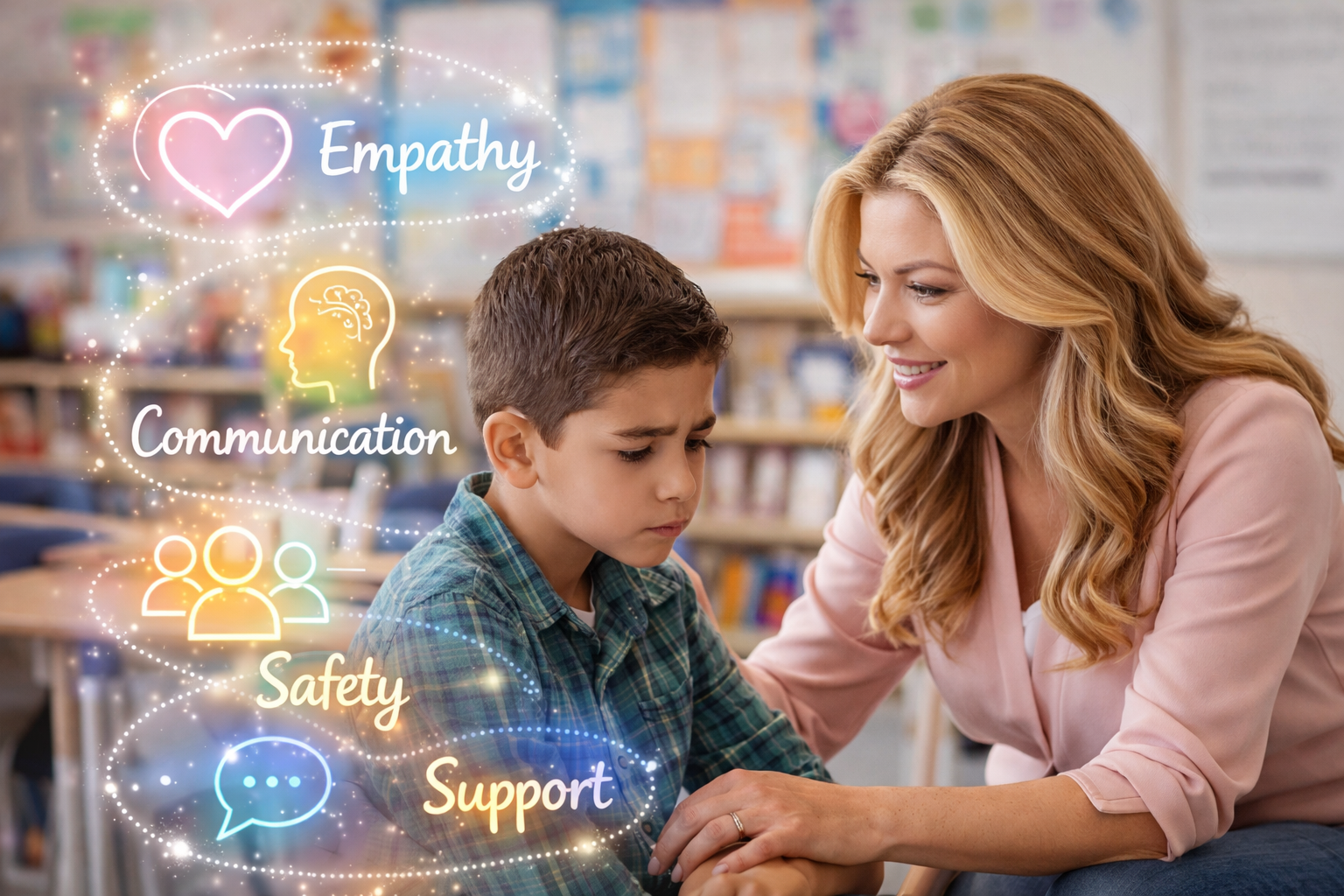
The Conversation That Changed Everything
I sat across from a principal in Singapore last year who told me something that stopped me cold.
“Natalia,” she said, “we’ve invested millions in AI systems, adaptive platforms, and intelligent tutoring software. Our data analytics are exceptional. But our teachers are exhausted, and our students are lonely.”
She paused, then added: “The technology works perfectly. The humanity doesn’t.”
That conversation crystallized something I’ve been wrestling with throughout my two decades in education: in a world increasingly shaped by artificial intelligence, the most valuable skill educators can develop is emotional intelligence.
Not despite the technology. Because of it.
The Central Question: What Does Education Actually Mean?
Artificial intelligence is reshaping education at unprecedented speed. Algorithms personalize learning pathways. Robots provide instant feedback. Data dashboards track every metric.
But here’s what troubles me:
Education has never been purely about information transfer. If it were, students could simply download knowledge, no teacher required. Education is about transformation.
It’s about helping young people discover who they are, what they’re capable of, and what they have to contribute to the world. That work is fundamentally human. It requires empathy, intuition, presence, and emotional connection.
Research on emotional intelligence shows us why it matters. Individuals with strong emotional intelligence—the ability to recognize, understand, and regulate emotions in themselves and others—demonstrate greater resilience, better decision-making, and stronger relationships (Kondratenko et al., 2020).
More importantly for education: students don’t learn effectively from people they don’t trust. They don’t develop confidence in environments where they feel unseen.
Technology can deliver content, but only humans can deliver belonging.
The Risk We’re Taking: Efficiency vs. Humanity
Here’s what I observe in schools worldwide: we’re becoming extraordinarily efficient at delivering education while inadvertently creating isolated learners.
A student sits with an AI tutor that adapts perfectly to their learning pace. The algorithm is flawless. But the student has no one to turn to when they feel overwhelmed. No one who notices they’re struggling emotionally before they fall academically.
Research exploring humanoid robots in education highlights this tension. While robots can simulate supportive behaviors, they cannot generate genuine empathy or respond to the subtle emotional signals that make learning feel safe (You et al., 2025).
When a student is confused, they need more than better explanation. They need someone to see their confusion, validate it, and communicate: “This difficulty means you’re learning something new. I believe you can do this.”
That belief—communicated through tone, presence, and authentic human connection—cannot be replicated by algorithms.
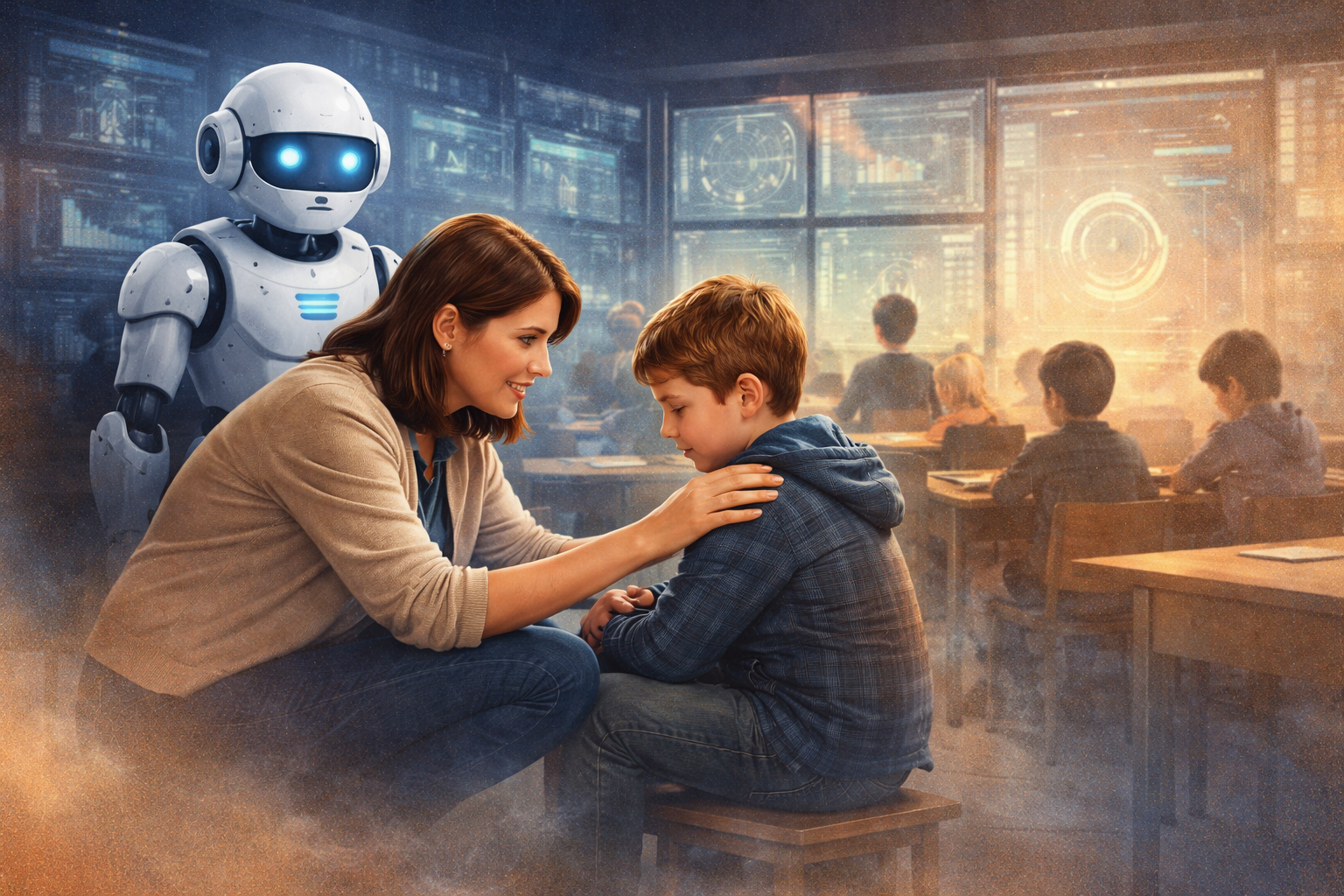
What Emotional Intelligence Actually Does in Classrooms
Let me be specific about what I mean by emotional intelligence in education. It’s not touchy-feely or soft. It’s the foundational capacity that enables learning to happen.
Emotional intelligence in teaching includes:
- Self-Awareness: Understanding your own emotional patterns and how they affect students. A teacher who recognizes their own frustration can choose how to respond rather than react defensively.
- Empathetic Listening: Hearing not just words but the feelings beneath them. When a student says, “I don’t get this,” emotional intelligence means understanding whether they’re confused about content, anxious about performance, or doubting their capability.
- Emotional Safety: Creating classroom climates where students feel psychologically secure enough to take intellectual risks. Research is clear: threat shuts down the prefrontal cortex. Safety opens it (Lieberman & Eisenberger, 2009).
- Social Awareness: Noticing the quiet student who’s struggling in silence. The anxious high-achiever masking perfectionism as confidence. The disengaged learner hiding beneath apparent compliance.
- Relationship Building: Investing genuine time and care in knowing your students as whole people, not data points.
This is the invisible architecture of effective teaching.
And here’s what’s crucial: when you build emotional intelligence into your leadership, academic outcomes improve. Students taught by emotionally intelligent teachers demonstrate greater persistence, higher engagement, and stronger resilience when facing setbacks (Kondratenko et al., 2020).
Technology doesn’t do this. Humans do.
The Teacher’s Role Is Changing—Not Disappearing
I want to be clear about something: I’m not anti-technology.
Artificial intelligence has genuinely powerful applications in education. It can free teachers from administrative tasks. It can provide personalized learning pathways. It can help identify students who need additional support.
But technology should be a tool that enhances human connection, not replaces it. The future classroom—the one I’m working toward—looks like this:
- AI handles: personalized content delivery, data analysis, adaptive pacing, routine administrative tasks.
- Teachers provide: mentorship, emotional development, belief-building, ethical reasoning, resilience-building, empathy cultivation.
In this model, technology becomes a partner. It takes care of what machines do well so teachers can focus on what humans do irreplaceably.
But this requires educational leadership that prioritizes emotional intelligence above all else.
Three Ways to Build Emotional Intelligence in Your Leadership
Based on my work with educators across multiple countries, here are three concrete practices that transform classroom culture:
1. Practice Intentional Presence
Be fully present with your students. Not checking your phone. Not thinking about your next class. Genuinely attending to who’s in front of you.
This single shift—emotional presence—tells students: “You matter enough for my full attention.” It’s also how you notice emotional signals that data dashboards miss.
2. Separate Behavior from Identity
This is the practice I dive deep into in The Language of Teaching.
When a student struggles, you have a choice:
- “You’re not focused.” (judges identity)
- “I notice you’re distracted. Let’s refocus together.” (describes behavior)
The difference seems small. The neurological impact is massive.
Identity-based criticism activates threat. Behavioral observation activates learning (Dweck, 2006).
3. Build Belief Before Content
Before you teach academic content, teach students to believe in their capability to learn that content.
This sounds simple. It’s not. It requires you to genuinely see potential in students even when they can’t see it in themselves. To communicate, through words and presence, that you believe in their growth.
Students internalize these beliefs. They become self-fulfilling prophecies.
A Story That Changed My Understanding
Years ago, I worked with a high school teacher named Marcus who was technically excellent but emotionally distant. His lessons were structured. His feedback was precise. His students’ test scores were good, but the students weren’t engaged, they weren’t curious, they were compliant.
We spent time examining his language and his presence in the classroom. What we discovered: Marcus was withholding emotional warmth because he thought distance meant professionalism. He believed: “Caring too much clouds my judgment.”
Over a semester, Marcus deliberately shifted. He began acknowledging the human being behind each question. He shared moments of genuine uncertainty. He celebrated growth, not just perfection.
The transformation was remarkable.
His students became curious, they took intellectual risks and started believing they were capable of deep thinking.
Nothing changed except his emotional presence.
But everything changed.
The Future Is Not Either/Or—It’s Both/And
I sometimes encounter educators who see emotional intelligence and technological advancement as opposing forces. They’re not.
The most effective schools I work with are using technology intelligently while strengthening human-centered practices. They’re implementing AI adaptive learning platforms while ensuring teachers have time for mentorship. They’re using data analytics while prioritizing emotional awareness. They’re modernizing while preserving humanity.
This both/and approach requires educational leaders who understand psychology, communication, empathy, and technology integration equally well.
It requires leaders who see emotional intelligence not as a soft skill but as the foundational competency of effective education.
What Students Actually Need from You
Let me be direct about what research tells us students need from educators in this technological age:
- They need someone who sees them—not just their data, but them.
- They need someone who believes in them—even when they don’t believe in themselves.
- They need someone who teaches them to think, not what to think.
- They need someone who makes them feel capable of handling difficulty and uncertainty.
These needs are irreducibly human. No algorithm can meet them.
This is why, in an age of artificial intelligence, emotional intelligence becomes the most valuable leadership competency an educator can develop.
The Real Competitive Advantage
Here’s what many schools miss: the competitive advantage in 21st-century education is not technological superiority, it’s human superiority.
Schools with the most advanced technology but the lowest emotional intelligence will lose students and families to schools that prioritize belonging and belief-building, because when students feel they can get knowledge anywhere, they choose to learn where they feel known.
This insight fundamentally changes how we think about educational leadership and teacher development.
Your Path Forward
If you’re ready to strengthen emotional intelligence in your leadership—and help your educators do the same—the foundation is communication.
The words you speak. The presence you bring. The beliefs you communicate.
In The Language of Teaching, I provide a comprehensive framework for using psychology-based, NLP-informed communication strategies to build emotionally intelligent classrooms.
You’ll discover:
- How to separate behavior from identity in ways that build confidence
- Specific language patterns that activate growth mindset
- How to create psychological safety through intentional communication
- Practical strategies for mentoring resilience
- How to become an architect of belief in your students’ minds
This isn’t theory. It’s tested, research-backed practice that works in real classrooms with real students.
Discover The Language of Teaching — your blueprint for human-centered educational leadership in the age of AI.
The Final Truth
Artificial intelligence will continue transforming education. That’s certain.
What’s equally certain is this:
Not schools with the most technology, but schools with the deepest humanity, because in a world of intelligent machines, what makes humans irreplaceable is our capacity to inspire, believe in, and transform one another.
That’s your superpower. That’s your responsibility.
Use it wisely.
References
Dweck, C. (2006). Mindset: The New Psychology of Success. Random House.
Kondratenko, A.B., Rudinskiy, I.D., Kondratenko, B.A. and Kravets, O.J., 2020. Emotional intelligence development: necessary modern technologies in students training. Journal of Physics: Conference Series.
Lieberman, M., & Eisenberger, N. (2009). The painful side of social cognition. Trends in Cognitive Sciences, 13(1), 36-42.
You, Z., Ahmad, S.F., Yan, F., Irshad, M., Garayev, M. and Ayassrah, A.Y.B., 2025. Investigating the impact of safety, cultural and character traits issues in the adoption of humanized robots in education. Humanities and Social Sciences Communications.